

When Canada faces New Zealand on the rugby pitch, the scoreline rarely tells the full story. These encounters have shaped Canadian rugby far beyond wins and losses, serving as critical benchmarks that expose gaps, reveal potential, and force the kind of systemic growth that decades of domestic competition simply cannot deliver. Since the first meeting between these nations in 1991, New Zealand’s dominance has been undeniable, yet each match has provided Canadian players, coaches, and administrators with invaluable lessons that continue to influence how the game develops from coast to coast.
The relationship between Canadian and New Zealand rugby stretches back over three decades, marked by World Cup clashes and touring matches that have tested Canada’s best against one of the sport’s most formidable powers. For a nation still building its rugby infrastructure, these high-stakes contests offer exposure that accelerates player development and raises the bar for domestic programs. Young athletes in Quebec and across Canada watch these matches not as exercises in futility but as proof of what elite rugby demands: technical precision, tactical discipline, and the physical conditioning required to compete at the highest level.
Understanding this dynamic matters now more than ever. With rugby’s quiet rise gaining momentum across the country, Canadian teams need meaningful international competition to transform grassroots enthusiasm into world-class performance. New Zealand provides that crucible. Every scrum, every lineout, every defensive set against the All Blacks becomes a masterclass that filters down through national programs into provincial clubs and community pitches. The question isn’t whether Canada can match New Zealand’s historical success, but how these encounters continue to drive Canadian rugby toward its own distinct excellence.
The Canada-New Zealand Rugby Legacy: A Tale of Two Nations
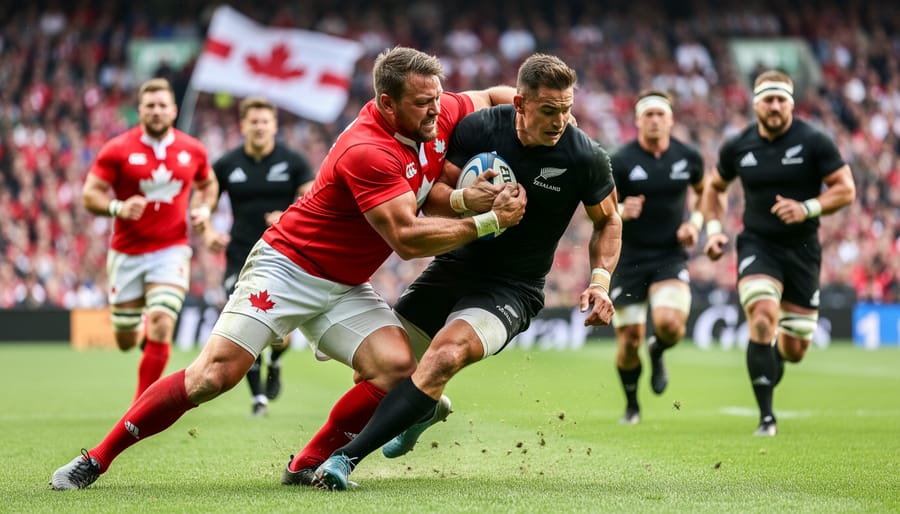
The first official meeting between Canada and New Zealand on the rugby pitch came in 1991, when the All Blacks visited Toronto as part of their North American tour. That 13-29 loss set the tone for a relationship defined by respect, aspiration, and hard-fought lessons. Over three decades and multiple encounters, New Zealand has consistently presented Canada with the standard of excellence every rugby nation measures itself against.
The 2011 Rugby World Cup clash in Wellington remains etched in Canadian rugby memory. Facing the eventual champions on home soil, Canada put forth a spirited performance that showcased moments of brilliance before falling 13-79. While the scoreline reflected the gap between the teams, the match demonstrated something vital: Canada could compete at phases, execute set pieces under pressure, and earn the All Blacks’ full attention. New Zealand’s coaching staff afterward praised Canadian physicality and work rate, recognition that meant more than sympathy.
These encounters have never been just about results. Each match against New Zealand provides Canadian players with a masterclass in decision-making, support play, and the relentless pace that defines tier-one rugby. When Canada faced the All Blacks in the 2019 World Cup in Japan, losing 0-63, returning players brought home not defeat but detailed understanding of the mental preparation, tactical adjustments, and fitness standards required to close that gap.
The All Blacks have become Canadian rugby’s north star precisely because they represent achievable excellence built on smart systems rather than population size alone. New Zealand’s 5 million people support a rugby powerhouse through deliberate pathways, community investment, and a culture that values the sport at every level. Canada, with similar population scale and a passion for team sports, sees a roadmap rather than an impossible dream.
Beyond the pitch, exchanges between Rugby Canada and New Zealand Rugby have fostered coaching clinics, shared training methodologies, and mutual respect that transcends scorelines. Several Canadian coaches have completed development programs in New Zealand, returning with fresh perspectives on player welfare, skill progression, and the importance of building from grassroots up. This relationship has evolved from one-sided competition into genuine partnership, where New Zealand’s willingness to share knowledge accelerates Canadian development in ways that matter far beyond match day.
Learning from the Best: How New Zealand’s Model Influences Canadian Rugby
Building Community Connections
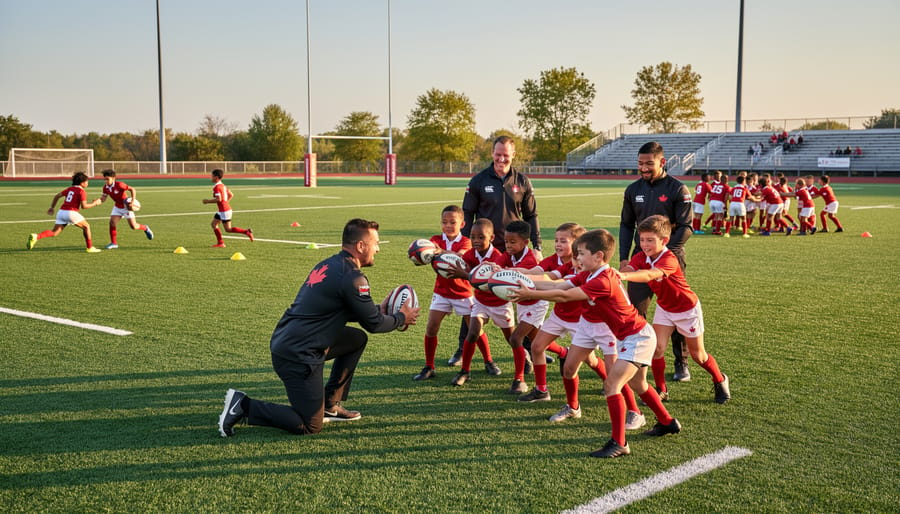
New Zealand’s rugby success stems from a simple principle: the sport belongs to everyone. In small towns and major cities alike, rugby clubs function as social hubs where families gather, volunteers thrive, and players of all abilities find their place. This community-first philosophy has struck a chord with Canadian rugby organizers who recognize that elite performance starts with grassroots engagement.
Quebec has embraced this model with particular enthusiasm. Local clubs now prioritize family involvement, hosting post-match barbecues and volunteer appreciation events that mirror the Kiwi tradition of rugby as community glue. The province has expanded youth programs that welcome beginners without intimidation, creating pathways where a child’s first touch of the ball happens in a supportive, inclusive environment rather than a pressure-filled trial.
The results speak clearly. Rugby is growing across Canada precisely because clubs have shifted from treating participants as potential future stars to celebrating them as community members first. This approach strengthens the entire pyramid: more players at the base means more talent emerging at the top.
Provincial unions across the country have adopted New Zealand-inspired club development workshops that teach volunteers how to build sustainable programs rooted in social connection. This community rugby growth creates the cultural foundation Canada needs to compete internationally while ensuring the sport remains accessible to everyone who wants to play.
Player Development Pathways
New Zealand’s player pathway looks like a well-oiled conveyor belt: youth clubs feed provincial academies, which supply Super Rugby teams, which stock the All Blacks. Every step connects clearly to the next. Canada, by contrast, has historically struggled with fragmentation. Talented teenagers might shine at school tournaments but find no obvious route forward, no structure tracking their progress toward higher levels.
That’s changing. Rugby Canada has drawn directly from the All Blacks blueprint, establishing regional academies and identification camps that mirror New Zealand’s age-grade system. The goal is a transparent ladder where a promising 14-year-old can see the climb ahead: provincial team, national age-grade squad, university or club development program, then the senior national team pipeline. Coaches now share databases and scouting reports across provinces, reducing the risk that talent slips through gaps simply because someone moved cities or played for a smaller club.
Quebec has embraced this model with particular energy, formalizing pathways through Centres d’excellence and partnerships with schools that feed into national programs. Young players train alongside mentors who themselves competed internationally, creating knowledge transfer that used to happen only by luck. The structure isn’t yet as seamless as New Zealand’s decades-old machine, but the bones are in place, and early results show more Canadian teenagers staying engaged and progressing rather than drifting away from the sport.
Recent Encounters: What Canada Has Gained from Facing the All Blacks
Every meeting between Canada and New Zealand serves as a masterclass in elite rugby, and Canadian players have extracted invaluable lessons from these encounters. The physical intensity of facing the All Blacks has pushed Canadian forwards to refine their breakdown work and defensive line speed, while backs have learned to make split-second decisions under relentless pressure. These matches aren’t just about the scoreboard, they’re about exposing gaps in technique, fitness, and tactical awareness that only become visible against world-class opposition.
The 2019 encounters proved particularly instructive. Canadian players faced the All Blacks’ trademark quick ruck ball and fluid attacking patterns, experiences that immediately translated into improved training standards back home. Lessons from Game Two highlighted how Canadian players gained crucial understanding of phase play continuity and support angles that separate tier-one rugby from developing programs.
Beyond physical preparation, the mental resilience required to compete against the All Blacks has transformed Canadian rugby culture. Players learn to maintain composure when opponents execute near-perfect phases, to stay disciplined when momentum shifts, and to recognize opportunities in moments that once seemed overwhelming. This psychological growth ripples through the entire national program, younger players training alongside All Blacks-tested veterans absorb these lessons secondhand, raising the collective standard.
The tactical education has been equally profound. Canadian coaches have studied how New Zealand exploits defensive misalignments, creates numerical advantages through decoy runners, and maintains defensive pressure for eighty minutes without lapses. These insights now inform Canadian game plans, training drills, and video analysis sessions. Players who once struggled to read attacking patterns can now anticipate them, and forwards who previously reacted to breakdowns now actively compete for dominant positions.
Perhaps most importantly, these encounters have shown Canadian rugby what elite consistency looks like. The All Blacks’ ability to execute skills under fatigue, maintain system discipline when trailing, and capitalize on fleeting opportunities sets a tangible standard. Canadian players return from these matches not discouraged, but inspired, armed with specific areas to improve and a clearer vision of the work required to bridge the gap.

Quebec’s Contribution to Canada’s Growth Against Top-Tier Nations
Quebec has quietly become a powerhouse in feeding talent to Canada’s national rugby program, particularly during high-stakes encounters with elite nations like New Zealand. The province’s rugby ecosystem has produced players who thrive under the pressure of facing the world’s best, demonstrating both technical skill and the mental fortitude required at the international level.
Phil Mack, a scrum-half developed through Quebec’s club system, exemplified this contribution during Canada’s 2019 encounters with tier-one nations. His quick decision-making and composure under the All Blacks’ relentless pressure showcased how Quebec’s competitive domestic environment prepares players for the speed and intensity of Test rugby. Similarly, Hubert Buydens, the prop who earned over 40 caps for Canada, honed his foundational skills in Montreal’s rugby community before becoming a cornerstone of the national pack in matches against New Zealand.
The province’s coaching depth has also shaped Canada’s approach to elite competition. During the Crowley coaching tenure Quebec-based coaches contributed tactical insights drawn from their experience developing players who could compete physically with larger nations while maintaining the skill-focused game necessary against technically superior opponents.
Quebec’s club infrastructure provides a crucial training ground. Teams like Westmount and Montreal’s rugby organizations create year-round competition that mirrors international intensity. This environment produces players accustomed to structured gameplay and tactical discipline, exactly what’s needed when facing the All Blacks’ systematic excellence.
The province’s bilingual rugby community also brings diverse perspectives to national team culture. French-speaking players and coaches enrich Canada’s tactical vocabulary and foster inclusive team environments that welcome different approaches to the game. This cultural depth strengthens squad cohesion during demanding tours against top-tier nations, where mental resilience matters as much as physical preparation.
The Road Ahead: Canada’s Vision for Closing the Gap
Canada’s vision for narrowing the gap with rugby powerhouses like New Zealand rests on three interconnected pillars: sustained international exposure, strategic domestic investment, and community engagement that starts at the grassroots level.
Rugby Canada has committed to seeking more frequent matches against Tier 1 nations, recognizing that occasional encounters aren’t enough to bridge the development divide. The national program is pursuing multi-year agreements that guarantee regular fixtures against top opposition, allowing players to accumulate the high-pressure experience needed to compete consistently at the elite level. These matches serve as both diagnostic tools and accelerators, revealing specific areas where Canadian rugby must improve while pushing athletes beyond their comfort zones.
Domestically, the focus shifts to building depth across all positions. Canada can’t afford to rely on a handful of standout performers when facing teams with New Zealand’s resources. Provincial academies are expanding their reach, identifying talent earlier and providing structured development environments that mirror international standards. Quebec’s contribution proves particularly vital here, as the province’s growing rugby community supplies technically skilled players who understand team-first systems.
The benchmark New Zealand sets isn’t just about winning Test matches; it’s about creating a culture where excellence becomes habitual. Canadian rugby is working to instill that mindset through consistent messaging, professional standards at the national team level, and pathways that reward commitment and performance.
Community involvement amplifies this vision. When local clubs understand their role in the national picture and why it matters now they become invested partners in Canada’s rugby journey. Every youth coach, volunteer administrator, and weekend warrior contributes to the ecosystem that eventually produces Test-level athletes capable of challenging the world’s best.
The relationship between Canadian and New Zealand rugby extends far beyond the scoreboard. Every match, every training session, and every exchange between these nations plants seeds for the future of rugby across Canada. When young players in Quebec watch their heroes take the field against the All Blacks, they see what’s possible. They witness the standard of excellence we’re striving toward, and more importantly, they see a clear path forward for Canadian rugby.
This isn’t about matching New Zealand tomorrow. It’s about building something sustainable, something distinctly Canadian, while learning from the world’s best. The progress we’ve made, stronger development pathways, better coaching education, more competitive performances, proves that consistent exposure to elite competition accelerates growth in ways nothing else can.
For Quebec’s rugby community, this means opportunity. Every provincial club that develops a national team player contributes to this journey. Every coach who brings new ideas to their local program strengthens the foundation. Every parent who supports their child’s rugby dreams helps build the depth we need to compete consistently at the highest level.
The gap is closing, match by match, season by season. But it requires all of us, players, coaches, families, and supporters, to stay committed to the work. The next generation is watching, waiting for their turn to wear the maple leaf. Let’s give them a program worth believing in.