
Rugby’s greatest moments aren’t measured in tries or penalties alone. They’re the split-second decisions, the underdog victories, and the displays of sportsmanship that transcend the scoreboard and remind us why millions around the world love this sport. From Jonah Lomu’s devastating runs that redefined what a winger could be, to Nelson Mandela’s jersey presentation that united a nation, these 15 moments capture rugby at its most thrilling, heartbreaking, and inspirational.
What makes a rugby moment truly great? It’s the convergence of athletic brilliance, historical significance, and emotional resonance. The best moments create stories that get passed down through clubhouses and living rooms, shaping how new generations understand the game. They inspire young players in Quebec communities and across Canada to chase their own moments of glory, whether on the World Cup stage or a local pitch on a Saturday afternoon.
This collection celebrates rugby’s capacity to create heroes, forge identities, and bring people together. You’ll find moments that showcase raw power and delicate skill, team unity and individual genius, triumph and graceful defeat. Whether you witnessed these moments live or discovered them through grainy footage and enthusiastic retelling, they form the shared heritage that connects everyone who has ever laced up boots or cheered from the stands.
How We Chose These Iconic Moments
Choosing fifteen moments from decades of Rugby World Cup history wasn’t easy. We looked beyond spectacular tries and dominant victories to find moments that truly changed rugby, not just who won, but how the game connects people and builds communities.
Our selection criteria focused on:
- Historical significance that shifted how rugby is played or perceived globally
- Emotional resonance that transcended the final score and touched fans worldwide
- Embodiment of rugby’s core values: respect, discipline, integrity, and inclusivity
- Impact on growing the game in new communities or inspiring underrepresented groups
- Moments that demonstrated how sport can unite people across cultural and social divides
We prioritized moments that reflect Quebec Rugby’s commitment to accessibility and community development. Some selections celebrate powerhouse nations, while others honour emerging rugby countries taking their first steps on the world stage. Athletic excellence matters, but these moments earned their place because they inspired the next generation of players, brought diverse communities together, or showed that rugby’s greatest victories happen off the scoreboard as often as on it.
1. Nelson Mandela and the Springboks Unite a Nation (1995)
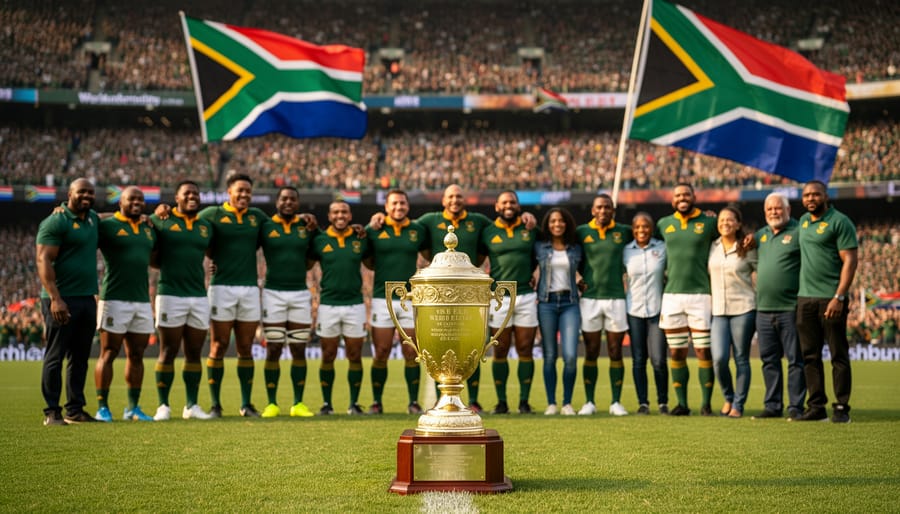
When President Nelson Mandela walked onto the pitch at Ellis Park on June 24, 1995, wearing a Springbok jersey with captain Francois Pienaar’s number 6, he transformed rugby from a symbol of division into a beacon of hope for a new South Africa.
The moment Mandela handed the Webb Ellis Cup to Pienaar transcended sport entirely. For decades, the Springboks had represented apartheid’s exclusionary policies, a team that Black South Africans actively rooted against. Yet here stood Mandela, released from prison just five years earlier, embracing rugby as a tool for national reconciliation. When Pienaar told reporters the team had the support of 43 million South Africans, not just the white minority who traditionally followed rugby, he acknowledged a fundamental shift.
The Springboks’ victory over New Zealand that day mattered less than what it represented: a country choosing unity over resentment. Mandela understood rugby’s cultural power among Afrikaners and used it strategically to bridge racial divides. Stadium crowds that once chanted exclusively in Afrikaans now sang together in multiple languages.
This moment demonstrated rugby’s unique capacity to heal communities and bring people together across seemingly insurmountable differences, values that remain central to growing the sport inclusively today.
2. Jonah Lomu’s Unstoppable Performance (1995)
At just 20 years old and weighing 119 kilograms, Jonah Lomu transformed what people thought was physically possible in rugby. During the 1995 World Cup semi-final against England, he trampled over defender after defender, scoring four tries in a 45-29 victory that left commentators struggling for words. His combination of size, speed, and power was unprecedented, he ran around, over, and through opponents who simply had no answer.
What made Lomu’s performance transcend sport was timing. The 1995 tournament was rugby’s first as a professional game, and suddenly millions of casual viewers worldwide witnessed something they’d never seen. His devastating runs became the tournament’s defining images, replaying on news broadcasts far beyond typical rugby markets. Children who’d never held a rugby ball wanted to play like Lomu.
His impact extended beyond that single tournament. Lomu became rugby’s first global superstar, appearing on mainstream television shows and magazine covers, making the sport accessible to audiences who previously saw it as niche or regional. He proved rugby could produce athletes whose appeal crossed cultural and geographic boundaries.
For developing rugby nations, Lomu’s success demonstrated that physical gifts combined with skill could compete at the highest level, inspiring coaches and players to rethink training methods and athlete development across the rugby world.
3. France’s Miracle Semi-Final Comeback Against New Zealand (1999)
With ten minutes left in the 1999 semi-final at Twickenham, New Zealand led 24-10 and looked destined for the final. What happened next remains one of rugby’s most astonishing turnarounds. France’s late comeback saw them score 33 unanswered points in the closing stages, winning 43-31 in a performance that defied logic and tactical convention.
Christophe Lamaison orchestrated the revival with 28 points, while Christophe Dominici’s try sparked the impossible. The French abandoned structure for instinct, throwing the ball wide with reckless abandon while the All Blacks imploded under pressure. Commentators struggled to process what they were witnessing, a meltdown on one side, pure rugby chaos on the other.
This moment captures why we love the sport. No lead is safe. No script is written. France proved that belief and audacity can overturn even the most comfortable advantages. For players in Quebec and anywhere else, it’s a reminder that matches aren’t decided until the final whistle, and that sometimes the most memorable victories come from refusing to accept defeat.
4. England’s Drop Goal Victory in Extra Time (2003)
With the score locked at 17-17 and just 26 seconds remaining in extra time, England fly-half Jonny Wilkinson dropped for goal with his weaker right foot. The ball sailed between the posts, and England claimed their first World Cup title with a 20-17 victory over Australia at Sydney’s Stadium Australia. Wilkinson’s winning drop goal represented the culmination of years of relentless practice, he was known for staying after training to kick hundreds of balls from every angle, in every condition.
The moment showcased what separates good players from great ones: Wilkinson’s ability to execute under maximum pressure, in front of a hostile crowd, with a tournament on the line. His preparation had been meticulous. He’d visualized the scenario countless times, practiced the mechanics until they became muscle memory. When scrumhalf Matt Dawson delivered the pass, Wilkinson’s technique held firm despite exhausted legs and screaming nerves.
That single kick demonstrated rugby’s unique blend of physical endurance and mental fortitude. It wasn’t just about skill, it was about staying composed when everything mattered most, a lesson that resonates with players at every level.
5. Japan’s ‘Miracle of Brighton’ Against South Africa (2015)
September 19, 2015, Brighton Community Stadium. Japan faced South Africa, a team that had won the World Cup twice and was ranked among the tournament favourites. What unfolded over the next eighty minutes rewrote rugby’s understanding of what was possible.
Trailing 32-29 with time expired, Japan earned a penalty in kickable range. Most teams would take the three points for a draw. Instead, captain Michael Leitch made the call: scrum. Japan would go for the try and the win. Five metres out, the Brave Blossoms executed phase after phase against the tiring Springbok defence. On the fourteenth pick-and-go, wing Karne Hesketh dove over in the corner. Final score: 34-32.
The result shocked the rugby world, but the victory was no accident. Coach Eddie Jones had spent years building a team culture based on relentless fitness and precision execution. Japan’s players, many holding full-time jobs, trained with an intensity that matched any professional squad. They studied South Africa’s patterns obsessively and trusted their game plan completely when it mattered most.
The Brighton miracle proved that rugby success comes from more than size and tradition. Smart preparation, unwavering belief, and collective commitment can level any field.
6. New Zealand’s Haka Before the 2011 Final
The All Blacks performing Ka Mate in front of 61,000 fans at Eden Park before the 2011 final against France remains one of rugby’s most stirring moments. Playing at home for the first time since the inaugural tournament, New Zealand felt immense pressure to claim only their second Webb Ellis Cup. The haka that night carried extra weight, a cultural ceremony channeling ancestral strength while the nation watched.
What made this moment transcend sport was how rugby has always honored the haka as sacred tradition rather than mere pre-match theatre. The French players stood respectfully in their V-formation, acknowledging the Māori war dance without trivializing it. This mutual respect between opponents demonstrates rugby’s core values.
The ceremony’s emotional intensity connected players to their heritage and unified a country behind them. New Zealand’s 8-7 victory that followed seemed almost secondary to the cultural pride displayed beforehand. Just as the haka enriches rugby culture globally, rugby’s rise in Canada shows how the sport embraces diverse communities while respecting local traditions and building something meaningful together.
7. Canada’s Historic First World Cup Win (1991)
On October 8, 1991, in Bayonne, France, Canada secured their first-ever Rugby World Cup victory by defeating Fiji 13-3 in a pool match that marked a turning point for Canadian rugby. The Canadians, led by captain Mark Wyatt and featuring powerful forwards like Al Charron and Gareth Rees at fly-half, controlled the match through disciplined defense and tactical kicking. Gareth Rees contributed crucial points with his boot, while the forward pack outmuscled the traditionally flashy Fijian side in wet conditions that suited Canada’s grinding style.
The victory wasn’t just about the scoreline. It proved that Tier 2 nations could build competitive programs through grassroots development and commitment to the sport’s fundamentals. Canada went on to reach the quarter-finals that year, their best-ever World Cup finish, inspiring a generation of young Canadians to take up rugby. That 1991 team showed what’s possible when communities invest in player development, coaching education, and building rugby culture from the ground up, a legacy that continues to shape Canadian and Quebec rugby programs decades later.
8. South Africa’s Back-to-Back Championships (2019)
When Siya Kolisi lifted the Webb Ellis Cup at Yokohama Stadium in 2019, he didn’t just captain South Africa to their third World Cup title, he shattered a symbolic barrier that had stood for generations. The first Black captain to lead the Springboks, Kolisi’s journey from a township in Port Elizabeth to rugby’s pinnacle embodied the transformative power of sport.
The 32-12 victory over England was dominant, but the significance reached far beyond the scoreline. Kolisi’s leadership united a team that reflected modern South Africa’s diversity. His emotional post-match words, “We have so many problems in our country, but to have a team like this, we come from different backgrounds, different races, and we came together with one goal”, resonated globally.
This moment paralleled what nations like Canada vs New Zealand represents: rugby’s ability to bridge divides and build inclusive communities. The Springboks proved that when a team truly represents its people, it becomes something bigger than sport. Kolisi’s captaincy opened doors for aspiring players who’d never seen themselves reflected in leadership positions, demonstrating that rugby belongs to everyone willing to commit to its values.
9. Brian O’Driscoll’s Hat-Trick Debut (1999)
Brian O’Driscoll arrived at the 1999 Rugby World Cup as a promising 20-year-old with just four senior caps. What happened next against the United States changed Irish rugby forever. The young centre scored three spectacular tries in a 53-8 victory, displaying speed, vision, and fearless running that announced a generational talent.
His first try came from a sweeping backline move. The second showcased raw pace as he burned past defenders on the outside. The third was pure instinct, identifying space, accelerating through it, and finishing with composure that belied his inexperience. Each score revealed different dimensions of his game.
This performance launched O’Driscoll into international stardom. He went on to captain Ireland to their first Grand Slam in 61 years, became the British and Irish Lions captain, and inspired countless young players across Ireland and beyond. His career demonstrates how World Cup moments create heroes who shape the sport for decades.
For developing rugby communities like Quebec’s, O’Driscoll’s debut offers a powerful lesson: big tournaments provide stages where young talent can emerge and capture imaginations, motivating the next generation to pick up a ball.
10. Australia’s Extra-Time Thriller Against South Africa (1995)
The 1995 semi-final between Australia and South Africa in Durban delivered edge-of-your-seat drama that kept fans worldwide glued to their screens. After 80 minutes, the score stood locked at 18-18, forcing rugby’s first-ever World Cup extra-time period.
What unfolded was a masterclass in composure under extreme pressure. Both teams had chances to seal victory. South Africa’s Joel Stransky kicked a drop goal to put the Springboks ahead 21-18, but Australia’s Michael Lynagh responded with a try that silenced the crowd. The Wallabies held on through the final minutes to win 27-21, advancing to face New Zealand in the final.
This match showcased everything that makes rugby special: bone-crunching tackles, tactical kicking battles, and moments of individual brilliance when fatigue should have won. The physicality was relentless, yet both teams maintained discipline and respect throughout.
For younger players watching today, this game demonstrates that mental strength matters as much as physical ability. When you’re exhausted and the pressure mounts, staying focused on executing your skills separates good teams from great ones. That lesson applies whether you’re playing in a World Cup semi-final or a community match in Quebec.
11. The First Women’s Rugby World Cup Final (1991)
Before thousands of spectators at Cardiff Arms Park in April 1991, the United States women’s team made history by defeating England 19-6 to become the first-ever women’s Rugby World Cup champions. This watershed moment came at a time when women’s rugby was still fighting for recognition and resources, making the achievement even more significant.
The American squad, composed largely of players who had taken time off work and self-funded their participation, demonstrated that passion and determination could overcome institutional barriers. Their victory wasn’t just about one match, it validated years of grassroots organizing by women who loved rugby and refused to accept that it was “not for them.”
England, despite hosting the tournament and being tournament favorites, couldn’t match the Americans’ physicality and tactical discipline. The USA’s forwards controlled the set pieces while their backs executed with precision, building a lead that England never seriously threatened.
This final opened doors globally. It proved women’s rugby deserved a world stage and could attract significant crowds and media attention. Within Quebec and Canada, the tournament inspired the formation of new women’s clubs and school programs, showing young girls that rugby was a sport where they belonged and could excel at the highest level.
12. New Zealand’s Unbeaten Tournament Run (2015)
When New Zealand lifted the Webb Ellis Cup at Twickenham in October 2015, they achieved what no team had done in three decades of World Cup history: successfully defended their title. The All Blacks went through the tournament unbeaten, scoring 270 points across seven matches while conceding just 76, a display of dominance that rewrote the record books.
What made this achievement remarkable was not just winning, but the sustained excellence required to stay at the top. Unlike teams that catch lightning in a bottle for a single tournament, New Zealand’s back-to-back championships demonstrated systematic development, depth across positions, and a rugby culture where excellence is the baseline expectation. Players like Richie McCaw, Dan Carter, and Ma’a Nonu competed at peak level across two World Cup cycles, showing remarkable physical and mental resilience.
The 34-17 victory over Australia in the final was convincing but never comfortable, a fitting end to a tournament where New Zealand faced challenges from France, South Africa, and Argentina. This unbeaten run proved that sustained success comes from strong structures, not just talented individuals.
13. Wales’ Historic Semi-Final Appearance (2011)
Wales arrived at the 2011 World Cup semi-final against France as genuine contenders, their attacking flair and forward power earning them a shot at their first final. But eighteen minutes in, captain Sam Warburton lifted French wing Vincent Clerc and drove him head-first into the ground. Referee Alain Rolland showed the red card immediately, and Wales faced 62 minutes with fourteen men.
What followed wasn’t a collapse but a masterclass in defensive resilience. Down a player, Wales fought for every inch, their line-speed never dropping, their physicality undiminished. They led 8-0 at halftime through a Stephen Jones try, defying the numerical disadvantage. France clawed back to 9-8, and that’s where it stayed. Wales threw everything at the French line in the final minutes, but the gap proved too much.
The moment stings for Welsh fans, yet it showcased rugby’s commitment to player safety and fair officiating over sentiment. Warburton’s tackle was dangerous under the laws, regardless of intent or occasion. The red card stood, and Wales, despite a heroic effort that earned global respect, went home. Sometimes the greatest moments aren’t victories but displays of character when the odds turn brutal.
14. Namibia’s First World Cup Try (1999)
When Namibia scored their first-ever Rugby World Cup try against Fiji in Bordeaux in 1999, it represented far more than four points on the scoreboard. For a nation where rugby infrastructure was still developing, that moment validated years of sacrifice and training by players who often held full-time jobs while representing their country.
The Welwitschias had lost their opening matches by wide margins, but they refused to simply make up the numbers. When their winger finally crossed the line, the celebration was pure and unrestrained, a reminder that World Cup moments aren’t measured solely in trophies. Every team brings their own journey, their own battles won just to reach the tournament.
These smaller rugby nations face challenges larger countries rarely consider: limited funding, fewer domestic competitions, and sparse coaching resources. Yet their presence enriches the World Cup, exposing more people to rugby’s values and creating pathways for the sport to flourish in new regions. Quebec’s rugby community understands this growth mindset, every club that forms, every youth program that launches, writes its own chapter in rugby’s expanding story.
15. The Introduction of Tier 2 Nations to the Tournament

The World Cup’s expansion beyond traditional powerhouses stands as one of rugby’s most transformative decisions. When the tournament opened its doors wider to emerging nations, it sparked a revolution in how the sport develops globally.
Georgia’s fierce pack dominance, Uruguay’s passionate fanbase, and Namibia’s consistent qualification have proven that Tier 2 nations deserve their place. These countries don’t just participate, they compete, upset favorites, and inspire entire regions to pick up a rugby ball. Portugal’s 2023 qualification after decades of effort shows how persistence pays off.
This expansion mirrors the community rugby growth happening across Canada. When smaller nations get World Cup exposure, their domestic programs flourish. Young players in Tbilisi, Montevideo, or Montreal see their countrymen on the world stage and dream bigger.
The investment in development pathways has also benefited established teams, with increased competition shaping our national team preparations and forcing tactical evolution. Rugby’s future depends on this inclusive approach, giving every nation the chance to write their own World Cup moment.
What These Moments Teach Us About Rugby
These fifteen moments reveal rugby’s unique capacity to transcend sport and forge lasting community bonds. From Mandela’s gesture of reconciliation to Japan’s tactical brilliance in Brighton, each highlights values Quebec Rugby holds central: respect for opponents, courage under pressure, and the belief that every player deserves a place in the game regardless of background or experience level.
The pattern across decades shows that unforgettable rugby emerges not from domination alone but from genuine sportsmanship, inclusive team cultures, and moments when players embody something larger than themselves. The Springboks’ back-to-back titles under Siya Kolisi, Wales’ dignified response to a controversial red card, and the expansion giving Namibia its first try all reinforce that rugby’s strength lies in welcoming everyone who shares its values.
You don’t need a World Cup stage to create meaningful moments. Quebec’s rugby community builds on the same foundation through youth development programs, women’s leagues gaining traction, and the grassroots momentum that brings new faces to pitches across the province. Every training session, local match, and post-game gathering where respect and camaraderie take centre stage adds to rugby’s living legacy, proving that the game’s greatest lessons play out wherever people gather to honor its spirit.
Frequently Asked Questions
When was the first Rugby World Cup held?
The inaugural Rugby World Cup took place in 1987, co-hosted by New Zealand and Australia. The All Blacks won the first tournament, defeating France 29-9 in the final at Auckland’s Eden Park.
What makes a World Cup moment truly memorable?
The most iconic moments combine sporting excellence with broader significance, they inspire communities, embody rugby’s core values of respect and teamwork, or mark turning points in how the game is played and perceived globally.
How can I get involved with rugby in Quebec?
Quebec Rugby offers programs for all ages and skill levels, from youth development to adult recreational leagues. Visit local clubs across the province to try the sport, attend matches, or volunteer as a coach or official.
Does the World Cup help grow rugby at the community level?
Absolutely. Each tournament inspires thousands of new players worldwide who watch these memorable moments and want to experience rugby themselves. Local clubs often see increased participation following World Cup years, as fans turn spectators into active participants.
These questions reflect what newcomers and existing fans ask most often about the tournament’s legacy. The World Cup happens every four years, bringing together the best teams and creating moments that resonate far beyond the final whistle. Whether you watched Mandela unite South Africa or Japan shock the rugby world, these experiences connect us to something larger than individual matches. They remind us why we gather on rugby pitches every weekend, striving to create our own memorable moments through commitment, respect, and shared effort.