
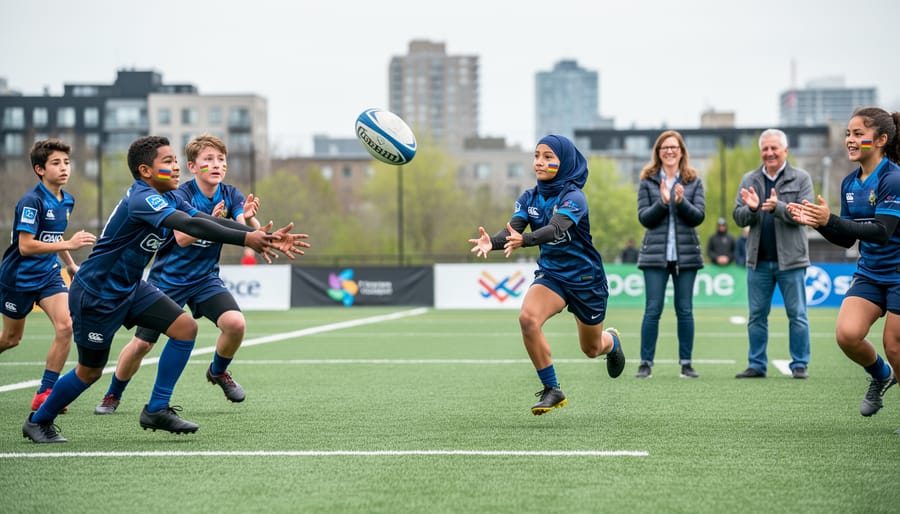
Rugby in Quebec welcomes everyone, full stop. Whether you’re a newcomer to Canada, a parent looking for your child’s first team sport, a woman interested in trying contact rugby, or someone who simply wants to belong to something bigger, the provincial rugby community has built deliberate pathways to bring you in. Programs like Touch Rugby for beginners, adapted formats for players with disabilities, and partnerships with community centers across Montreal, Quebec City, and regional towns mean that participation doesn’t require prior experience, a certain body type, or fluency in either official language.
This wasn’t always the case. Rugby in Quebec has evolved from a sport played primarily in anglophone private schools to a provincial movement that reflects the diversity of Quebec itself. Today’s clubs field teams in over a dozen languages, host newcomer integration sessions in partnership with settlement agencies, and run women’s and girls’ programs that have tripled participation since 2020. Coaches receive mandatory training in inclusive practices, and Rugby Quebec has formalized anti-discrimination policies that apply to every registered club.
The results speak louder than policy documents. Walk onto a pitch in Laval, Sherbrooke, or Gatineau on a Saturday morning and you’ll see players from Haiti training alongside those from France, teenagers in hijabs passing to teammates in face paint, and parents from six continents cheering from the sidelines. This introduction explores how Quebec rugby turned inclusivity from an aspiration into daily practice, what specific programs exist for different communities, and exactly how you can join.
What Makes Quebec Rugby Truly Inclusive
Inclusivity at Quebec Rugby means more than welcoming everyone through the door. It means actively removing barriers that might prevent someone from stepping onto the pitch in the first place. The organization has built its programs around a fundamental belief that rugby belongs to anyone who wants to play, regardless of whether they’re five or fifty-five, whether they grew up playing sports or have never touched a ball, whether they speak French, English, or neither as a first language.
This commitment shows up in tangible ways. Registration fees include flexibility for families facing financial constraints. Equipment loans ensure that cost never stops someone from trying the sport. Clubs across the province offer bilingual coaching and communication, recognizing Quebec’s linguistic diversity. Many teams schedule practices at different times to accommodate work schedules, caregiving responsibilities, and student commitments.
The culture extends beyond logistics to how players treat each other. Quebec Rugby has established clear codes of conduct that prohibit discrimination and harassment based on gender identity, sexual orientation, race, religion, or ability. Coaches receive training not just in technical skills but in creating psychologically safe environments where players feel comfortable being themselves. Referees enforce respect on the field, and clubs foster it off the field through social events that bring together players from different teams and backgrounds.
What distinguishes Quebec’s approach is the understanding that inclusivity requires ongoing effort, not a one-time policy announcement. The organization regularly seeks feedback from participants, adapts programs based on community needs, and celebrates the diversity that makes its rugby family stronger. Players repeatedly mention feeling genuinely welcomed rather than tolerated, finding teammates who become friends and a sport that becomes part of their identity regardless of where they started.
Programs and Pathways for Every Player
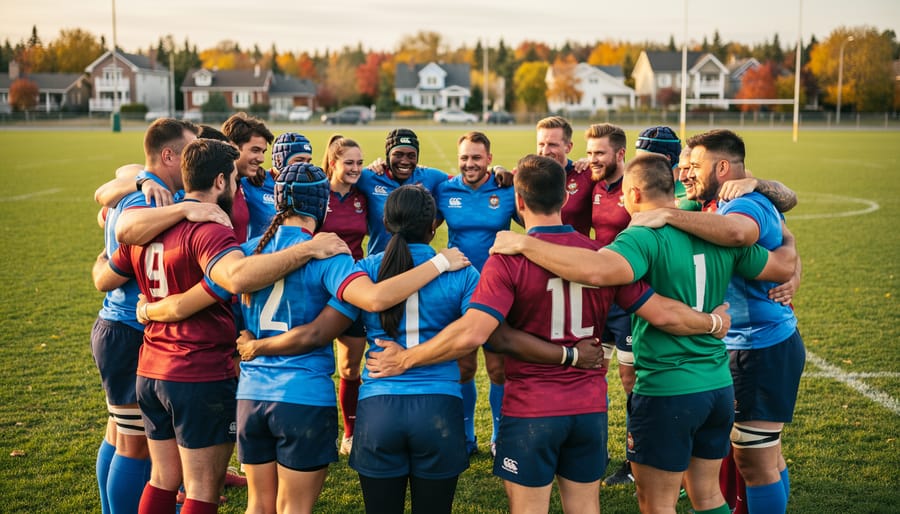
Youth and Grassroots Development
Quebec Rugby reaches young people through a network of school partnerships, community clubs, and introductory programs specifically designed for beginners. The Touch Rugby and Mini Rugby formats introduce children as young as five to the sport’s fundamentals in a non-contact environment where the emphasis is on fun, skill development, and teamwork rather than competition.
School-based initiatives bring certified coaches directly into classrooms and physical education programs across the province, ensuring that kids encounter rugby regardless of their family’s familiarity with the sport. These sessions require no prior experience and provide all necessary equipment, removing financial and knowledge barriers that might otherwise prevent participation.
Community clubs offer structured youth leagues organized by age group, with dedicated volunteer coaches trained in youth development principles. Many clubs run “try rugby” days throughout the year where curious kids can experience the sport without committing to a full season. The progression from introductory formats to full-contact rugby happens gradually, allowing young players to build confidence and skills at their own pace while discovering whether the sport resonates with them.
Women’s and Girls’ Rugby
Women’s rugby in Quebec has experienced remarkable momentum over the past decade, with participation numbers climbing steadily as more clubs establish dedicated women’s teams and girls’ development pathways. Today, female players can access competitive opportunities at every level, from youth introductory programs through high school leagues to senior provincial competitions and national team development streams.
The province supports year-round programming specifically designed for women and girls, including beginner-friendly sessions that teach fundamental skills in supportive environments. These programs recognize that many female players come to rugby later than their male counterparts and create entry points that build confidence alongside technique. Experienced coaches work to develop both athletic ability and leadership qualities, fostering an atmosphere where women feel empowered to try new positions and take on coaching or refereeing roles themselves.
Provincial leagues provide structured competition across age groups, while development academies identify and nurture talent for higher levels of play. Equipment lending programs and financial assistance options reduce barriers to entry, ensuring cost never prevents a young woman from discovering her potential in rugby. The growing visibility of women’s rugby, through increased media coverage and community celebration of female athletes, continues to inspire the next generation of Quebec players.
Adaptive and Para Rugby Opportunities
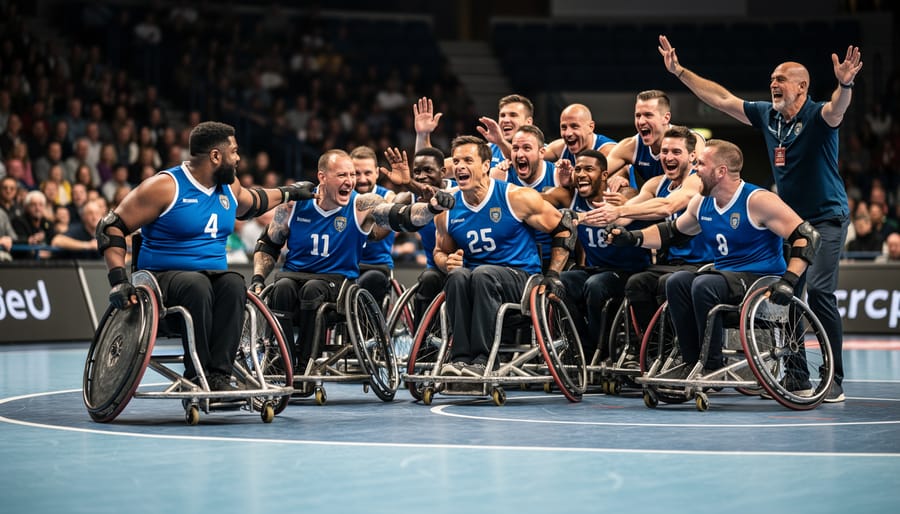
Wheelchair rugby stands as one of the most dynamic adaptive sports available in Quebec, offering full-contact competition for athletes with physical disabilities. The Wheelchair rugby program welcomes players with quadriplegia, cerebral palsy, muscular dystrophy, and other conditions affecting multiple limbs, creating teams where athletes of different functional abilities work together strategically.
Quebec Rugby supports connections to local wheelchair rugby clubs throughout the province, where new players can learn the quad rugby rules and experience the sport’s unique blend of speed, strategy, and physicality. These programs provide specialized equipment and coaching, ensuring players receive proper instruction in chair handling, positioning, and game tactics.
Beyond wheelchair rugby, the organization promotes awareness of other adaptive formats being developed internationally, including standing rugby variations for athletes with visual impairments or limb differences. Quebec’s rugby community actively works to identify barriers and create pathways for athletes with disabilities who want to participate in any capacity, whether as players, coaches, referees, or administrators, recognizing that adaptive sports enrich the entire rugby family.
Community Stories: Voices from Quebec’s Rugby Family
The real measure of inclusivity isn’t found in policies or mission statements. It lives in the stories of people who’ve discovered rugby in Quebec and found something they didn’t expect: a place where they truly belong.
Amara moved to Montreal from Haiti in 2019, speaking limited English and no French. At 28, she’d never touched a rugby ball. A coworker invited her to a women’s touch rugby session in Parc La Fontaine, and despite her nerves, she went. “Nobody cared that I couldn’t understand half of what was being said,” she remembers. “They showed me. They included me. By my third session, I was teaching the rules to someone else who was new.” Three years later, Amara coaches a girls’ development team and speaks French fluently, crediting rugby with giving her both a community and confidence in her new home.
Sixteen-year-old Thomas from Quebec City joined his school’s rugby program after years of feeling like he didn’t fit into traditional sports. As a non-binary teen, they worried about acceptance. Instead, they found teammates who respected their pronouns from day one and coaches who made sure everyone felt valued. “Rugby taught me I could be exactly who I am and still be part of something bigger,” Thomas says. “The physicality, the teamwork, the respect code, it all just clicked for me in a way nothing else had.”
Jean-Marc, a 52-year-old referee from Sherbrooke, came to rugby after watching his daughter play. He started officiating at 48 with no prior experience. “People think rugby is only for the young and athletic,” he laughs. “But there’s a role for everyone. I’m out there every weekend, staying active, learning constantly, and being part of matches that matter to these players. The rugby community made space for me when I thought my sporting days were behind me.”
These aren’t exceptional stories. They’re typical ones. Across Quebec’s rugby pitches, you’ll find newcomers and lifelong residents, fluent francophones and those still learning, experienced athletes and complete beginners. What unites them isn’t background or ability. It’s the shared experience of being welcomed into a sport that makes room for whoever shows up ready to play.
Creating Safe and Respectful Spaces
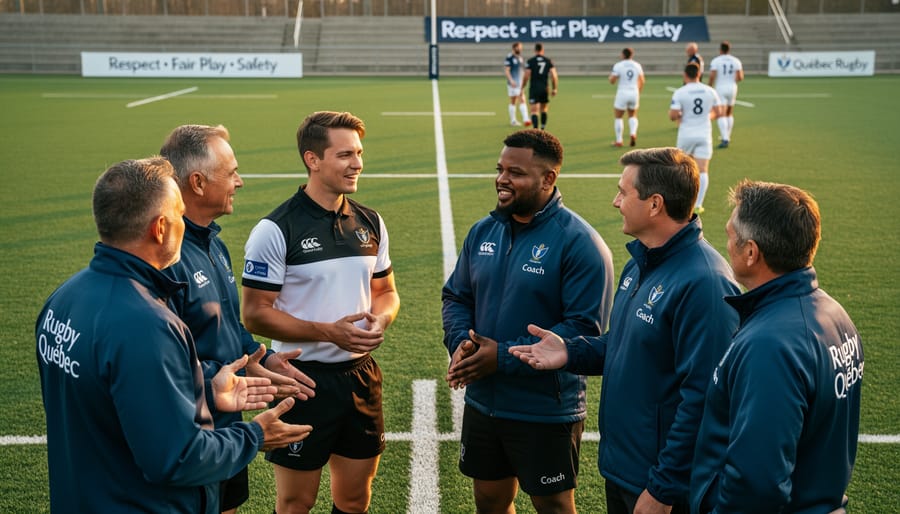
Quebec Rugby prioritizes creating environments where every participant feels physically and emotionally secure. The organization has established comprehensive policies and training programs that protect players while fostering a culture built on respect and dignity.
At the foundation sit clear anti-discrimination and anti-harassment policies that apply to everyone involved in the sport, players, coaches, officials, volunteers, and spectators. These policies explicitly prohibit discrimination based on gender, race, sexual orientation, religion, ability, or any other characteristic. When violations occur, defined reporting mechanisms and accountability processes ensure concerns are addressed promptly and seriously.
Physical safety receives equal attention through rigorous protocols. Quebec Rugby has adopted evidence-based concussion protocols for rugby that govern how head injuries are managed, from immediate removal from play through graduated return-to-sport procedures. Coaches and medical staff receive specific training to recognize symptoms and never rush players back onto the field. Understanding the long-term implications of head trauma, including CTE and safety considerations, has shaped how the organization approaches contact training and game management.
The Safe Sport initiative extends beyond injury prevention to encompass emotional well-being and appropriate conduct. All coaches and officials complete mandatory training covering topics like recognizing abuse, maintaining proper boundaries, responding to disclosures, and creating psychologically safe team cultures. Certification requirements ensure those working with youth understand their responsibilities in protecting vulnerable participants.
Quebec Rugby also emphasizes progressive coaching education that teaches proper technique to minimize injury risk while developing skills. Tackle progressions follow age-appropriate guidelines, and non-contact versions of the game provide pathways for those who prefer them.
Regular audits of club environments, anonymous feedback channels, and open communication with participants help identify areas needing improvement. This ongoing commitment means safety isn’t treated as a checkbox but as a constantly evolving priority that adapts as understanding deepens and best practices emerge.
How to Get Involved in Quebec’s Inclusive Rugby Community
Getting involved with Quebec Rugby is straightforward, regardless of which role appeals to you most. The organization has built clear pathways that make it easy to connect with the rugby community and find your place in it.
Start by visiting the Quebec Rugby website, where you’ll find a club locator showing teams and programs throughout the province. Most clubs welcome newcomers year-round, though registration periods typically run in spring for summer leagues and fall for winter programs. If you’re unsure which club suits you best, reach out to Quebec Rugby directly through their contact form, staff members can recommend options based on your location, interests, and experience level.
- Visit and use the club finder to locate programs near you
- Contact the club or program coordinator to learn about upcoming sessions and registration dates
- Attend an introductory session or open house to meet coaches and other participants
- Complete registration paperwork and any required safe sport training if applicable
- Show up to your first practice ready to learn and be part of the community
For those interested in coaching, refereeing, or volunteering, Quebec Rugby offers certification courses throughout the year. New referees can start with Rugby Canada’s Level 1 course, while coaching certifications range from community-level programs to advanced credentials. Many clubs actively seek volunteers for administrative roles, event coordination, and youth program support.
Supporters and sponsors can connect through Quebec Rugby’s partnership office to explore how they can contribute to the sport’s growth. Whether you bring corporate sponsorship, professional expertise, or simply enthusiasm for the game, there’s a way to make an impact.
The rugby community thrives on welcoming new faces. Don’t hesitate to reach out, ask questions, and take that first step onto the pitch or into the rugby family.
Common Questions About Joining Quebec Rugby
New players often have similar questions before taking their first steps into Quebec’s rugby community. These answers address the most common concerns and help you understand what to expect.
Do I need prior rugby experience to join?
No. Quebec Rugby welcomes complete beginners at clubs across the province, with many offering introductory programs specifically designed to teach fundamentals in a supportive environment. Coaches expect new players and structure sessions to accommodate different learning paces.
What are the typical costs involved?
Registration fees vary by club and program type, typically ranging from affordable youth rates to adult league fees that cover insurance, field access, and equipment. Many clubs offer payment plans or financial assistance to ensure cost isn’t a barrier to participation.
What equipment do I need to start?
Most clubs provide essential training equipment and jerseys. You’ll need cleats, shorts, and a mouthguard initially, with clubs often having loaner gear for first-time participants to try before investing in your own.
Are there age restrictions for adult programs?
Adult programs welcome players from late teens through masters categories for older players. Whether you’re 18 or 58, there’s a playing level and format suited to your age and fitness level.
Beyond these basics, prospective members frequently ask about time commitments. Training typically happens two evenings per week during the season, with matches on weekends. However, clubs understand that life gets busy and work with players who can’t attend every session.
Safety concerns come up regularly, particularly from parents and newcomers unfamiliar with contact sports. Quebec Rugby prioritizes player welfare through certified coaching, age-appropriate contact progressions, and comprehensive concussion protocols. Newer players learn proper technique before engaging in full contact, and non-contact formats like touch rugby provide alternatives for those who prefer them.
The welcoming atmosphere surprises many first-timers. Rugby’s culture emphasizes respect and camaraderie, with opponents sharing post-match gatherings and experienced players mentoring newcomers. This social dimension makes clubs feel like extended families rather than just sports teams, helping new members feel at home quickly regardless of their background or identity.
Quebec Rugby’s commitment to inclusivity isn’t a slogan, it’s woven into every program, policy, and practice across the province. As rugby’s rise in Canada continues, Quebec stands at the forefront of building a sport that genuinely welcomes everyone who shares values of respect, teamwork, and sportsmanship.
Whether you’re considering trying rugby for the first time, returning after years away, or looking to contribute as a volunteer or coach, there’s a place for you here. The barriers that once kept people from participating are being dismantled through deliberate effort and genuine community commitment.
The strength of Quebec’s rugby community lies in its diversity. Players from different backgrounds, abilities, and experiences don’t just coexist, they learn from one another, compete together, and build lasting friendships. This is what makes rugby special: it demands your best effort while accepting you exactly as you are.
Visit to find your local club, explore programs, and take that first step. The community is waiting, and your story is part of what makes Quebec rugby stronger.