
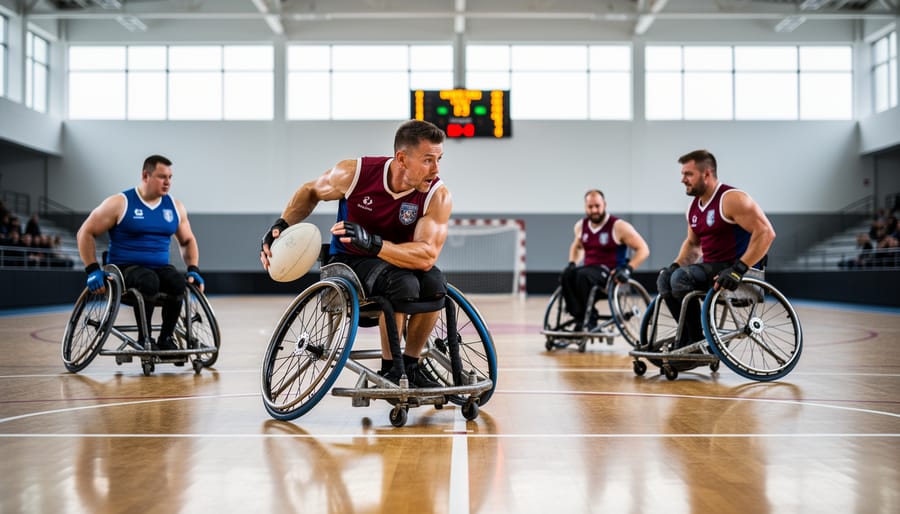
Understand the court dimensions and wheelchair classifications before stepping onto the playing field. Quad rugby, also known as wheelchair rugby, plays out on a standard basketball court with goal lines at each end. Teams field four players at a time, and each athlete receives a classification from 0.5 to 3.5 based on their functional ability. The total points of all four players on court cannot exceed 8.0, ensuring balanced competition and genuine inclusion for athletes with varying levels of quadriplegia or similar disabilities.
Master the contact rules to protect yourself and your teammates during play. Unlike traditional rugby, controlled collisions happen between wheelchairs, not bodies. Players can block, pick, and drive into opponents’ chairs, but contact above the axle or hitting an opponent’s chair from behind results in penalties. The sport emerged in Canada during the 1970s when athletes with quadriplegia sought a full-contact alternative to existing wheelchair sports, and these safety-focused regulations have evolved to prevent injuries while preserving the physical intensity that defines the game.
Learn the possession and scoring mechanics that drive each match forward. A team has 40 seconds to advance the ball across the center line and 12 seconds total to attempt a goal once in the attacking zone. To score, a player carrying the ball must cross the goal line with at least two wheels. Dropped balls, fumbles, and turnovers happen frequently, making quick transitions and defensive positioning essential skills for newcomers to develop.
The rules create opportunities for athletes of all ability levels within the quad rugby community. Lower-point players often excel at ball handling and offensive strategy, while higher-point athletes typically anchor defensive formations.
What Makes Quad Rugby Different: The Basics
Quad rugby, officially known as wheelchair rugby, emerged in 1977 when Canadian athletes with quadriplegia wanted a full-contact team sport that matched their competitive spirit. The game was originally called “murderball” due to its intensity, and it earned its Paralympic debut at Sydney 2000 cementing its place as one of the most dynamic adaptive sports in the world.
Unlike traditional rugby union or league, quad rugby is played indoors on a hardwood court similar to basketball, with four players per team instead of fifteen. The ball is round and volleyball-sized rather than oval, and players advance it by passing, carrying it on their lap, or dribbling. They must bounce or pass the ball at least once every ten seconds, creating a fast-paced rhythm that’s entirely distinct from rugby’s scrums and lineouts.
The adaptive nature shows most clearly in the classification system. Each player receives a point value from 0.5 to 3.5 based on their functional ability, with lower points indicating greater impairment. The four players on court can’t exceed 8.0 total points, ensuring balanced competition where athletes with different ability levels contribute strategically.
Quebec has seen steady growth in wheelchair rugby, with programs in Montreal and Quebec City offering newcomers a chance to experience the sport’s unique blend of strategy, speed, and sanctioned contact. The chairs themselves become extensions of the athletes, custom-built with angled wheels, bumpers, and spoke guards that transform mobility aids into precision instruments of competition.
Essential Equipment and Safety Standards
# Essential Equipment and Safety Standards
Quad rugby demands specialized equipment engineered for both performance and protection. Before you ever roll onto the court, understanding what gear you need, and why, is essential for your safety.
Your wheelchair is your primary piece of equipment, and not just any chair will do. Quad rugby chairs are built for impact. They feature a reinforced frame, anti-tip devices on the rear, and bumpers or wings that extend from the front and sides. These bumpers aren’t optional, they’re mandatory safety features that absorb collision forces and protect both you and other players during contact. Offensive chairs typically have a pointed front bumper for maneuverability, while defensive chairs sport wider wings designed to block and contain opponents.
Spoke guards are non-negotiable. These circular shields cover your wheels completely, preventing fingers, hands, or clothing from getting caught in the spokes during play. They also protect your wheels from direct impact. Most leagues require spoke guards on both wheels, and they must be smooth with no protrusions that could snag or injure another player.
Gloves give you grip and hand protection. Many players choose fingerless gloves with tacky palms for better ball control, while others prefer full-finger options with reinforced knuckles. The goal is protecting your hands from floor burns, pinches between chairs, and repetitive friction without sacrificing your ability to catch and pass.
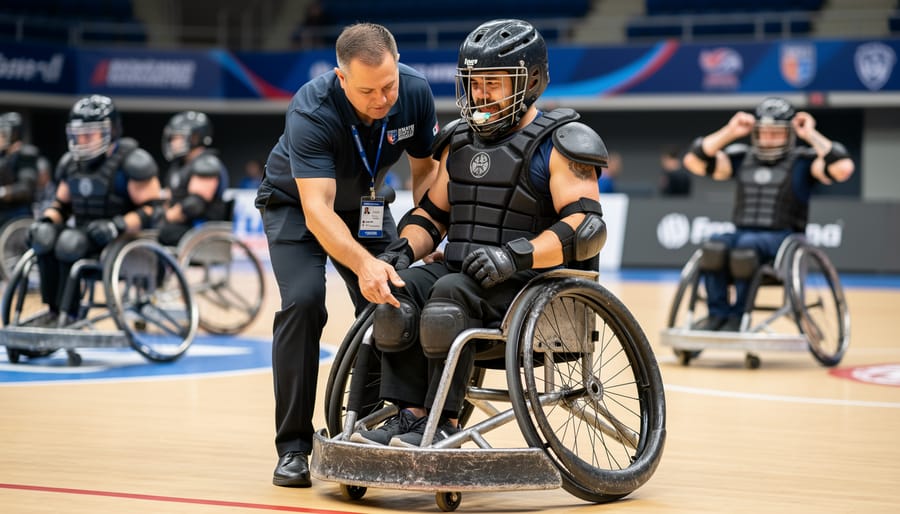
Additional protective gear varies by player need and classification. Chest straps secure you safely in your chair during aggressive play and collisions. Shin guards, knee pads, and elbow protection are common, especially for players with higher function who engage in more physical contact. Some players wear helmets, particularly those new to contact sports or with specific medical considerations.
Before every game and practice, chairs undergo safety inspections. Officials check for secure bolts, proper bumper attachment, spoke guard condition, and overall wheelchair integrity. This isn’t bureaucracy, it’s preventing equipment failure that could cause serious injury during high-speed collisions.
Core Game Rules That Protect Players
Court Dimensions and Team Composition
Quad rugby takes place on a regulation basketball court measuring 28 meters long by 15 meters wide, with clearly marked key zones at each end. Eight athletes compete at once, four per team, in a fast-paced game that blends strategy with physical skill. What sets quad rugby apart is its unique classification points limit a system that ensures fair and safe competition by balancing players of different functional abilities.
Each athlete receives a classification rating between 0.5 and 3.5 points based on their trunk control, upper body function, and ability to handle the ball. Lower classifications indicate more significant impairments, while higher numbers reflect greater functional ability. The total points of the four players on court cannot exceed 8.0 points at any time.
| Classification | Functional Ability | Typical Role |
|---|---|---|
| 0.5 – 1.5 | Limited trunk and arm function | Defensive specialist, screening |
| 2.0 – 2.5 | Moderate trunk control | Ball handler, support player |
| 3.0 – 3.5 | Strong trunk stability and arm function | Primary ball carrier, scorer |
This point system prevents teams from fielding only high-classification players, creating opportunities for athletes at all functional levels. It also reduces collision risks by ensuring teams maintain balanced lineups rather than stacking rosters with the most physically capable players, which could lead to dangerous mismatches on the court.
Contact and Collision Rules
Contact between wheelchairs is central to quad rugby, but strict rules govern what’s legal to prevent injuries and dangerous play. Understanding these boundaries is critical for new players.
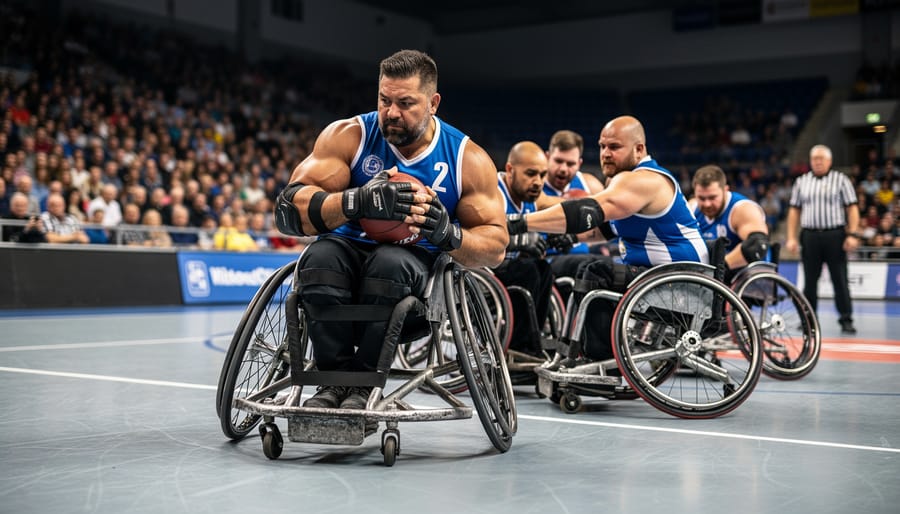
Legal contact occurs when players strike opponent wheelchairs from the front or side using the front third of their own chair. This forward-facing contact allows players to block, push, or hold opponents while maintaining control and visibility. The key is intentional, controlled wheelchair-on-wheelchair contact where both players can see each other approaching.
High-impact collisions from behind or directly into an opponent’s side wheels are prohibited. Ramming at excessive speed, especially targeting a player’s rear axle or anti-tip wheels, creates dangerous momentum that can flip chairs or cause whiplash injuries. Officials penalize these as personal fouls, removing the offending player from play temporarily.
Vulnerable players receive special protection. Any athlete carrying the ball cannot be contacted above the shoulders or struck in the side wheels while stationary. Defensive players must approach ball carriers from the front or use positional blocking rather than aggressive ramming. The one-metre rule prohibits defenders from hitting a player within one metre of the goal line during scoring attempts, creating a safety zone during the game’s most vulnerable moment.
Officials also restrict “hooking” where a defender uses their wheelchair to trap or entangle an opponent’s wheels, and “charging” where players accelerate from a distance specifically to create high-impact collisions. These rules balance the sport’s physical intensity with player protection.
Ball Handling and Possession Rules
In quad rugby, timing rules control the flow of play and reduce the risk of chaotic pile-ups that can lead to collisions or injuries. Once your team gains possession, you have ten seconds to advance the ball from your defensive zone into the offensive half of the court. This forces continuous movement rather than clustering players in one area where wheelchairs can tangle.
The 10-second and 40-second rules work together to keep the game moving safely. After crossing into the offensive zone, your team has 40 seconds total (from the initial possession) to attempt a goal. If you fail to score or cross the goal line within that window, possession switches to the opposing team. This countdown prevents players from stalling in tight spaces and eliminates prolonged standoffs where aggressive contact might escalate.
Possession changes whenever the ball goes out of bounds, a goal is scored, or a turnover occurs through a violation. The clock resets with each new possession, giving both teams equal opportunity while maintaining the rhythm that keeps players spread across the court rather than bunched in dangerous clusters.
Penalties and Their Safety Purpose
Quad rugby penalties fall into two main categories that directly protect players from harm. Technical fouls address procedural violations like lane violations, illegal timeouts, or touching the ball while out of bounds, these maintain game flow and prevent chaotic situations where collisions become more likely. Personal fouls carry more serious consequences because they involve dangerous actions: spinning an opponent’s chair excessively, hitting another player’s chair from behind, or making contact above the axle that could tip a wheelchair. These violations result in immediate penalty time, removing the offending player for one minute. Repeat offenders face ejection. The penalty structure isn’t just about fairness, it’s specifically designed to eliminate behaviors that could cause wheelchair damage, player injuries, or dangerous falls. New players should study these penalties carefully, as understanding what’s prohibited helps you play aggressively within safe boundaries rather than crossing lines that put everyone at risk.
Safety Protocols New Players Must Follow
Starting quad rugby means taking ownership of your safety from day one. Unlike able-bodied rugby where many safety protocols focus on tackling technique, quad rugby safety centers on equipment integrity, self-awareness, and clear communication with your team.
Before every training session or match, complete this essential pre-game safety checklist:
- Inspect your wheelchair frame for cracks, loose bolts, or structural damage that could fail during play
- Check all wheel components, including spoke tension, tire pressure, and axle security
- Verify that spoke guards are properly attached and free from cracks or loosening
- Test your strapping system to ensure it secures you firmly without restricting breathing or circulation
- Examine gloves for wear, especially in the palm and finger areas where grip is critical
- Confirm that all protective padding is in place and hasn’t shifted or deteriorated
These checks take five minutes but prevent equipment failures that cause the majority of preventable injuries in quad rugby.
Equally critical is understanding your classification and playing within those limits. If you’re classified as a 0.5 player with limited trunk control, don’t attempt the aggressive picks and screens that 3.5 players execute. Your coach and teammates need to know your capabilities and restrictions so they can position you effectively without putting you at risk.
Communication on court goes beyond calling plays. Announce when you’re entering a defensive zone, warn teammates about incoming opponents, and immediately report any equipment issues or physical discomfort. Quebec’s quad rugby community emphasizes that speaking up isn’t weakness, it’s the mark of an experienced player who prioritizes team safety.
Finally, respect recovery time between intense drills and games. Wheelchair athletes face unique fatigue patterns and pressure point concerns. Pushing through warning signs like numbness, skin irritation, or excessive fatigue increases injury risk exponentially.

Common Safety Mistakes and How to Avoid Them
New quad rugby players often make predictable mistakes that can lead to injuries or unsafe situations on the court. Recognizing these errors early helps you develop safer habits from the start.
**Overestimating Your Contact Skills**
Many beginners try to match the intensity of experienced players before they’ve mastered wheelchair control. This leads to poorly-timed collisions where you can’t properly brace for impact or protect yourself. Start with positional play and gradually increase your defensive intensity as your chair-handling skills improve. Quebec players frequently remind newcomers that effective defense comes from anticipation and positioning, not just force.
**Neglecting Pre-Game Equipment Checks**
Skipping wheelchair inspections before play is surprisingly common. Loose spoke guards, worn straps, or improperly inflated tires can fail during contact, leaving you vulnerable. Develop a consistent pre-game routine: check all bolts, inspect your anti-tip device, test your brakes, and examine straps for wear. This five-minute habit prevents most equipment-related incidents.
**Poor Communication During Fast Play**
Failing to call out screens, switches, or incoming contact catches teammates off guard and creates collision risks. Quad rugby moves quickly, and silent play leaves everyone guessing. Practice calling plays loudly and consistently, even during drills. Your voice is a safety tool.
**Ignoring Your Classification Limits**
Pushing beyond your classification’s physical capabilities, especially in the first months, increases injury risk. A 0.5-point player attempting the physical style of a 3.5-point player will struggle and potentially get hurt. Respect your classification and build skills within those parameters.
Quad rugby’s rulebook isn’t just a list of regulations, it’s a framework designed to protect every athlete on the court while preserving the sport’s intensity and competitive spirit. Each rule, from equipment standards to contact restrictions, serves a dual purpose: enabling thrilling gameplay and ensuring players return home safely after every match.
For new players in Quebec, understanding these rules marks the beginning of an incredible journey. The province’s quad rugby community welcomes athletes of all skill levels, offering training sessions where experienced players share insights, coaches break down complex rules, and everyone prioritizes safety alongside skill development.
Don’t wait to get involved. Quebec Rugby’s inclusive programs provide structured pathways for newcomers, connecting you with local clubs that emphasize proper technique, equipment maintenance, and gradual skill progression. Whether you’re in Montreal, Quebec City, or smaller communities across the province, there’s a welcoming team ready to support your development.
Reach out to Quebec Rugby today to find training opportunities near you. Join a community that celebrates both the fierce competition and the camaraderie that make quad rugby special. Your journey starts with understanding the rules, and continues with the friendships, achievements, and experiences you’ll gain on the court.